
by Ryan Cleek
How an unexpected reunion became an independent mountain bike documentary
About a half-dozen times a year when there’s a break in the commercial photography and filmmaking work that keeps the lights on, I make something entirely on my own terms.
Photography makes that relatively easy. Even if I’m lugging strobes around the mountains, I can head out for an afternoon and potentially come home with a single frame that tells the whole story. One strong image is forever that.
Filmmaking is different.
It requires more equipment, more shooting time, a concept, some kind of story arc and usually a ridiculous number of hours in post-production before the scattered pieces start resembling an actual film.
Still, independent films have always been some of my favorite things to make.
I independently created two feature-length mountain bike documentaries, Downhill Speed and Reach For The Sky, both almost entirely self-funded. I wrote, produced, directed, filmed and edited them around nights, weekends and vacation days. They each took more than two years to finish.
There’s something liberating about making a film without a client brief or marketing agenda attached to it. Find an interesting subject. Shoot what looks good. Keep an eye out for a story and pursue it wherever it may go, then figure out how all the ingredients can cook-up together later.
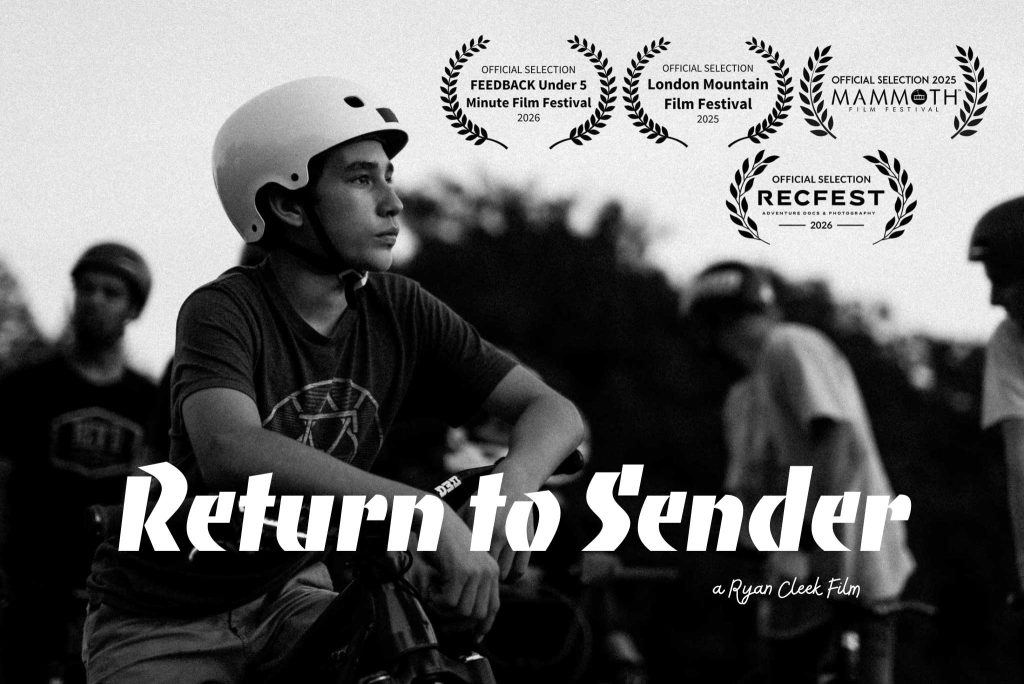
That was essentially how Return to Sender, my short mountain bike documentary featuring Connor Gallart, came together.
And it started completely by accident.
The accidental beginning of Return to Sender
On a chilly Saturday morning in March 2024, I planned to film a little winter mountain bike action video shoot with a handful of Tahoe-area shredders: Jonathan Gibbons, Damon Iwanaga, Jack Lilyquist, Jett Lloyd and Treyton Maskaly.
There wasn’t much of a production plan. We were going to spend a couple of hours riding and filming around Virginia City, Nevada, and I’d whip something up out of whatever footage we came home with. I had just had one of my Canon cinema cameras repaired, and there’s no better way to test it out than shooting under pressure.
That morning, Jonathan asked if a buddy of his “who rips” could join us. Considering the company Jonathan keeps, I figured another good rider certainly wasn’t going to hurt.
The guy who showed up was Connor Gallart. I knew Connor from my years living in Santa Cruz.
After 11 years as a staff photographer and writer for Mountain Bike Action, I left the magazine in 2012 and moved from Santa Monica to Santa Cruz to work in Specialized Bicycles’ Global Marketing department as a creative producer. During those years, I occasionally photographed riders at the legendary Post Office dirt jumps.
Connor grew up in Santa Cruz and was probably 14 to 17 years old during much of that period. Even then, he stood out as one of the young dirt jumpers coming up through a scene that had already produced some of the best freeride and slopestyle riders in mountain biking.
I hadn’t seen him in years. Then he randomly showed up at a winter mountain bike shoot in Nevada.
Filming winter mountain biking near Reno and Lake Tahoe
Our plan that day was simple. The riding area was Geiger Grade, a rough hillside outside Virginia City made mostly of sand, loose rock and volcanic dirt. It’s one of those places around the Reno-Tahoe region that can still be rideable when most of the higher-elevation mountain bike trails are buried under snow.
Wild horses wander around the area. Mark Twain once lived up the road. No one is going to confuse the terrain with Whistler Bike Park. Yet, we paint on the canvas in front of us.
My plan was to mix up focal lengths, compositions and frame rates while a group of very good riders did their thing. If everything worked, I figured I might get enough footage for a tight, fun 90-second mountain bike action edit.
We filmed Saturday morning. By Monday morning, the video was finished.
That became Frosty Freeride: Winter MTB Action in Reno-Tahoe.
I also like digging through public-domain film archives for old footage that can put modern action into a different context. I’d used that approach before, and it again proved useful in the above winter freeride video.
Finding a bigger story behind the riding
Before we started filming that morning, everyone gathered in the dirt turnout at the bottom of the riding area.
Connor and I knew each other from the Post Office days, but I hadn’t seen him since 2015, shortly before the jumps were demolished.
By coincidence, we ended up in the same shuttle truck heading up the mountain.
During that short drive, Connor mentioned that he had stepped away from riding years earlier to join the military. Now he was back on his bike and wanted to make mountain biking a significant part of his life again.
A lightbulb went off. I told him we should go back to Santa Cruz and make a film. Not just another riding edit.
I wanted Connor to talk about growing up around the Post Office dirt jumps, the Santa Cruz riding scene, why he stepped away from mountain biking and what it meant to return years later.
Then we’d combine that story with new riding footage.
I’ve made plenty of action edits over the years, and I still enjoy making them. But great action is usually the low-hanging fruit in action-sports filmmaking. Put a talented rider in front of a camera in the right location and you’re already halfway there.
The harder part is giving somebody a reason to care about the person on the bike.
Connor clearly still had the riding ability. He’s the guy throwing backflips in the long-sleeve black jersey in the Virginia City film.
Now there was a story behind it.
Returning to Santa Cruz to film Connor Gallart
From roughly March through Thanksgiving, my calendar is usually dominated by commercial photography and video production.
When I had a few open days between assignments that May, I pointed my trusty Suburban work camper toward the Pacific and drove from Reno to Santa Cruz.
Connor and I filmed the afternoon I arrived, then again the following morning and afternoon.
This was very much an independent production. No big crew. No elaborate schedule. No brand behind it. We went back to places that mattered to Connor, talked about his history in Santa Cruz and filmed new riding. We really didn’t shoot all that much. By the time I headed home, I felt like I had enough ingredients to cook with.
I organized and backed up the footage, then commercial work took over again and the film landed on the back burner.
For a while.
A broken arm creates some unexpected editing time
About a month later, I was preparing for my first downhill mountain bike race of the season.
I tried a new line on a track I knew well and crashed. Broken arm.
I’ve raced bikes since I was five years old, BMX from roughly five to 15 and downhill since 2000, and somehow I’ve managed to avoid breaking very many bones.
This one required surgery. It was only June and my racing and riding season was done, and I wouldn’t touch a bike again until October.
After feeling sorry for myself for a day or two, I realized I suddenly had something I normally don’t have much of during summer: time.
So I started editing.
Surgery was on Tuesday. By Thursday, I could kind of move a few fingers on my right hand, although my wrist was completely immobilized in a giant splint.
After some trial and error, I folded up a towel, rested my arm on it and positioned my fingers close enough to the trackball that I could operate my editing system.
I couldn’t really use the keyboard but a few fingers worked. Good enough.
I started Thursday morning and obsessively worked through the footage for most of the weekend. My ‘99 Tacoma is a manual, so I couldn’t exactly go anywhere anyway.
By Monday, the film was essentially finished, less some color and sound dusting up.
Rebuilding the history of the Post Office dirt jumps
There was still one significant problem.
A large part of Connor’s story revolved around the Post Office dirt jumps, and most of my original photography from that era no longer exists.
During the years I lived in Santa Cruz, my house was burglarized and a fireproof safe was stolen. Inside were dozens of sheets of slide film containing some of my favorite photographs from my very early years shooting full-time for Mountain Bike Action, along with several hard drives of digital images.
Nearly all of my photographs from the Post Office jumps were among them. Fortunately, plenty of other talented photographers documented that scene.
I reached out to Ian Collins, who had spent years photographing riders at Post Office as well.
Ian allowed me to license a handful of his images for the film. Roughly two-thirds of the black-and-white Post Office photographs that appear in Return to Sender are his. The remainder are from the small collection of my own images that survived that I scrounged up from dusty hard drives.
Those photographs became an important part of connecting Connor’s current riding to the place and period that helped shape him.
From an independent mountain bike film to four international film festivals
I’m my harshest critic and probably always will be. Every once in a while, though, I’ll make something I think might connect with an audience outside of mountain biking and throw it into a few festivals to see what happens.
Return to Sender was made independently with essentially no production budget.
There wasn’t a brand financing it or a production company assembling a crew. Connor brought his story and his riding. I wrote, produced, directed, filmed and edited the film.
Our budget was basically our time and effort, gas between Reno and Santa Cruz, and enough coffee and donuts to keep morale high.
Since its completion, Return to Sender has been selected to four international film festivals: the London Mountain Film Festival, Mammoth Film Festival, Feedback Film Festival, where it won Best Documentary, and the DaVinci International Film Festival’s Rec Fest, where it was selected as one of eight finalists.
For a film that started with a random conversation in a shuttle truck while I was shooting something else entirely, it has been pretty rewarding to see where it ended up.
More importantly, making Return to Sender reinforced something I’ve believed for a long time about mountain bike filmmaking.
The riding matters. The imagery matters. The locations matter.
But story is what gives all of it weight.
You don’t necessarily need a massive production budget to make something worthwhile. You need an interesting subject, a reason to make the film, and enough determination to keep your head down until all the pieces fit together. There’s no substitute for putting your ass in the chair and simply getting the process underway.
In this case, it started with a winter mountain bike shoot in Nevada, took us back to the Post Office dirt jumps in Santa Cruz and eventually became Return to Sender.
Not a bad return on an idea sparked on a 2 min truck ride to the top of a shuttle run.
Watch Return to Sender
Return to Sender is an independent short mountain bike documentary featuring Connor Gallart, following his return to riding while looking back at the Santa Cruz mountain bike scene and the Post Office dirt jumps that helped shape his early years.